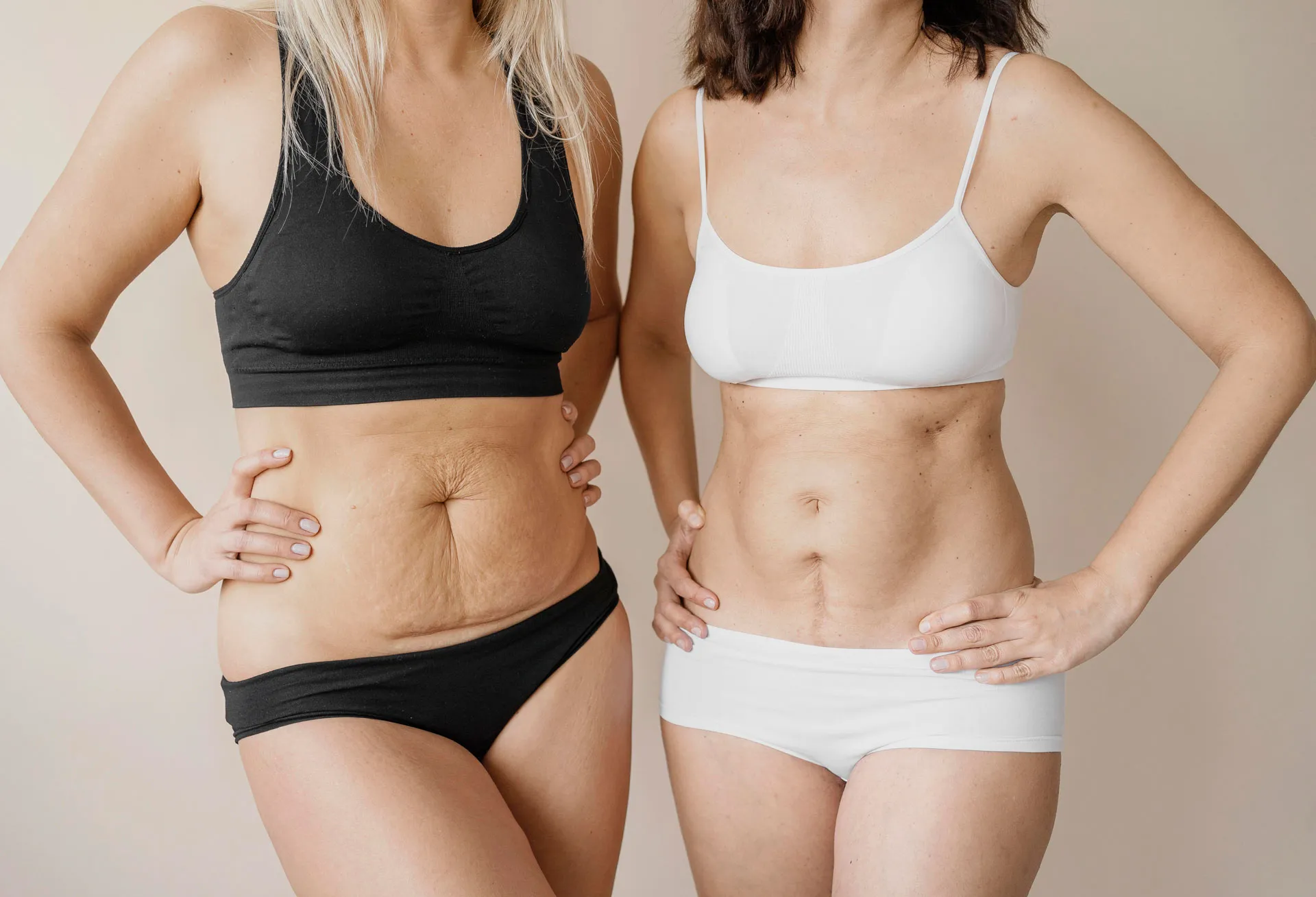
Has your abdomen never been the same since pregnancy? Many women manage to return to their pre-pregnancy weight, resume exercise, and even fit back into the same clothes they wore before becoming mothers. However, some still notice that their abdomen protrudes, feel a sense of laxity in the midsection, or simply cannot regain the abdominal contour they had before pregnancy.
In many cases, this is not just due to localized fat or excess skin. The cause may be a very common condition called abdominal diastasis, a separation of the abdominal muscles that often occurs during pregnancy and can persist even years after childbirth.
During pregnancy, the progressive growth of the baby puts significant pressure on the abdominal wall. To allow for this process, the rectus abdominis muscles gradually separate as the uterus increases in size. In many women, this separation partially corrects itself after childbirth. However, in other patients the muscles do not fully return to their original position, leaving a permanent gap in the abdominal midline.
One of the most common signs is that the abdomen maintains a "pregnant" appearance even after returning to your pre-pregnancy weight. Many patients say things like:
This happens because the problem isn't just about fat or skin; it's about the muscle structure that supports the entire abdominal wall.
Exercises focused on strengthening the core and deep abdominal muscles can help improve abdominal function and offer some improvement in mild cases. However, when the muscle separation is significant, exercise has its limitations because it cannot physically bring the separated muscles back together. That is why some patients, despite training regularly and maintaining healthy habits, continue to see a persistent abdominal bulge.
Diastasis may require surgery when the muscle separation is significant, or when there is a persistent abdominal bulge, sagging, excess skin, or when the patient is unable to improve their abdominal contour through healthy habits and exercise.
Surgery is not indicated simply because a separation exists. It is indicated when that separation affects the shape, support, or the results the patient is looking for, and when the conditions are right to operate safely.
With this information, we determine if the best option is a tummy tuck, a lipoabdominoplasty or another procedure.
A tummy tuck is one of the most effective procedures for correcting significant abdominal diastasis. During surgery, not only is any excess skin and tissue removed, but the abdominal wall is also repaired by bringing the abdominal muscles back into their proper position. This process allows you to:
That is why many patients are surprised to discover that the true benefit of the surgery comes not just from removing skin, but from correcting muscle separation.
No. Liposuction removes localized fat, but it does not join separated abdominal muscles. This is a key point because many patients come to their consultation convinced that they need liposuction to improve their abdomen. But if the main problem is diastasis, removing fat will not correct the cause of the bulging.
Liposuction can improve contour when there is localized fat and good skin quality. However, if there is muscle separation, significant sagging, or excess skin, it may not be enough. That is why a bulging abdomen after pregnancy is not always resolved with liposuction. It often requires a more structural correction.
Not all patients with diastasis need the same treatment. The approach will depend on factors such as the extent of muscle separation, skin quality, and each person's aesthetic goals. During the assessment, your anatomy is fully analyzed to determine if the best option is a tummy tuck, a lipoabdominoplasty or another complementary procedure.
The answer depends on the diagnosis:
That is why it is not about choosing a surgery by name. It is about understanding which structures are causing the problem. The post-pregnancy abdomen can involve fat, skin, muscle, or a combination of all these factors. Each one is corrected differently.
When diastasis is properly diagnosed and surgery is indicated, the correction can provide significant benefits.
It can improve:
Many patients initially seek a flatter abdomen, but after surgery, they also notice a feeling of greater firmness and control in their core.
The ideal timing depends on each patient, the type of delivery, recovery, breastfeeding, weight, general health, and body stability. It is not advisable to rush into abdominal surgery while the body is still recovering from pregnancy and childbirth.
During the assessment, we analyze whether the body is in a suitable condition for surgery, if weight is stable, and if the patient can comply with the necessary rest and postoperative care. Surgery should be planned for a safe time, not just when the patient wants to look better.
If your abdomen remains bulging, loose, or protruding after pregnancy, it is not always a matter of fat or a lack of exercise. There may be abdominal diastasis, excess skin, laxity, or a combination of factors that require a proper diagnosis.
When the muscle separation is significant, a tummy tuck or lipoabdominoplasty can be an effective tool to restore the structure of the abdominal wall and improve both the appearance and functionality of the abdomen. If you notice that your abdomen remains protruding despite your efforts or you suspect you might have abdominal diastasis, I look forward to seeing you at my office in Bogotá for a specialized assessment.
It is the separation of the rectus abdominis muscles along the midline. It can occur during pregnancy and persist after childbirth, causing a bulging abdomen or a feeling of weakness.
You might suspect it if your abdomen remains protruding after pregnancy, if you feel weakness in your core, or if a bulge appears along the midline when you exert yourself. A diagnosis must be confirmed through a medical evaluation.
In some women, it may improve after childbirth. In others, the separation persists. The outcome depends on the severity of the diastasis, tissue quality, and postpartum recovery.
It can help in mild cases and improve abdominal function, but when the separation is significant, exercise may not be enough to physically bring the muscles back together.
No. Liposuction removes localized fat, but it does not repair separated muscles.
A tummy tuck (abdominoplasty) can correct significant diastasis by repairing the muscular wall. If there is also localized fat, a lipoabdominoplasty may be recommended.
Yes. A tummy tuck can remove excess skin and improve abdominal laxity, in addition to repairing diastasis when indicated.
Yes, many patients with a history of C-sections are candidates. During the consultation, we review the previous scar, skin condition, diastasis, and the appropriate surgical plan.
It depends on your recovery, breastfeeding, weight, general health, and body stability. It is important to wait until your body is ready and you are able to manage the postoperative period.
It can be affected by a new pregnancy, significant weight gain, or improper strain during recovery. That is why it is important to follow postoperative instructions.

Agenda una consulta de valoración y recibe una atención personalizadaSchedule an assessment consultation and receive personalized attention to design a plan that enhances your beauty with confidence and confidence. Your dream result starts here!
¡Tu resultado soñado comienza aquí!